
Stages of Change: Meeting Yourself Where You Are
Embark Therapeutic Services, LLC


Why Change Feels Like a Tug-of-War
Start by addressing the elephant in the room: most people wait until they are in a crisis to try to change, and then they feel like failures when that change doesn't happen overnight.
The Reframe: Change isn't a light switch; it’s a physiological and psychological "re-wiring."
The Goal: Introduce the Transtheoretical Model (Stages of Change) not as a set of rules, but as a map to help you locate where you are right now so you don't waste energy using the wrong tools for the wrong stage.
Pre-contemplation: The "Not Ready" Stage
The Internal Monologue: "I don't have a problem," or "It’s just how I am."
The Clinical Reality: This isn't "denial"; it’s often a protective mechanism. The nervous system doesn't feel safe enough yet to consider a different reality.
The Skill: Self-Compassion. The goal here isn't to change behavior; it's simply to become a "curious observer" of your own life.
Contemplation: The Land of "Yes, But..."
The Internal Monologue: "I know I should, but I'm not sure I can."
The Clinical Reality: This is the home of Ambivalence. In ACT, we look at this as a conflict of values. You value health, but you also value the "safety" or "comfort" of the old habit.
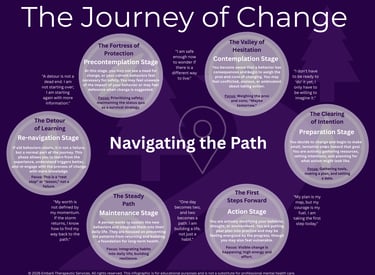
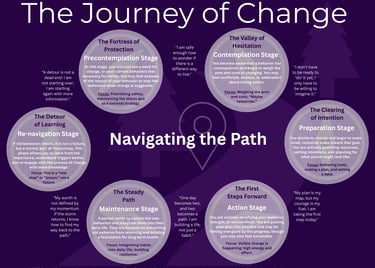
The Skill: Decisional Balancing. (Point to the infographic here). This is where you weigh the "cost of staying the same" against the "cost of changing."
Preparation & Action: Building the Infrastructure
The Internal Monologue: "I'm doing it, but it feels clunky."
The Clinical Reality: This is the "clutchiest" part of the process. You are moving from the "What" to the "How."
The Skill: Small Wins. This is where the "Elemental Skills" (Pacing and Boundary Setting) come into play. You aren't just taking action; you are practicing the skills that make the action sustainable.
Maintenance & Relapse: The Spiral, Not the Ladder
The Internal Monologue: "I messed up. I'm back at square one."
The Clinical Reality: Relapse is a stage, not a failure. In the spiral model, when you "slip," you don't go back to the very bottom; you land back in Contemplation or Preparation with more data than you had last time.
The Skill: Data Collection. Ask: "What was the 'headwind' that pushed me off course?" Use that information to adjust your "sails" for the next lap.
The Tool: Tracking Your Spiral
Recovery and growth are easier to navigate when you have a map. We’ve developed a visual guide to the Stages of Change to help you identify your current phase and the specific skills needed to move forward.
Download The Journey of Change: Navigating the Path Infographic (PDF). Visit our Educational Handouts page for more resources.
From Survival to Sustainable Living: Trusting the Spiral
If there is one truth to take away from the Transtheoretical Model, it is this: Where you are right now is exactly where you need to be to learn the next skill. When we view change as a ladder, we live in constant fear of falling. But when we view it as a spiral, we realize that "looping back" is actually an opportunity to deepen our foundation. Moving from Action back to Contemplation isn't a failure; it is your nervous system asking for more information, more support, or perhaps a slower pace.
Integration as a Practice
Sustainable living is built in the quiet moments between the stages. It’s found in the decision to be honest about your ambivalence, the courage to ask for help during the preparation phase, and the self-compassion required to stay regulated when things don't go as planned.
At Embark Therapeutic Services, we don’t just focus on the "Action" stage. We honor the "Quiet Grief" of the identity shifts that happen in Contemplation and the "Biological Budgeting" required to maintain long-term progress. Whether you are circling a familiar challenge or stepping into a brand-new season of growth, remember that the goal is not to move as fast as possible, but to move with as much awareness and kindness as possible.
Your Next Step
Change is a heavy lift, but you don't have to carry the map alone.
Reflect: Use the The Journey of Change: Navigating the Path infographic to identify your current "season" without judgment.
Practice: Choose one small, manageable skill that matches that stage.
Connect: If you find yourself stuck in the "Yes, but..." of contemplation, or if the "Action" phase feels unsustainable, reach out.
Through individual counseling and clinical support, we can help you navigate the spiral and build a life that feels authentic, grounded, and—above all—sustainable.
Connect
© 2026 Embark Therapeutic Services, LLC. All rights reserved.
If you're in crisis or feeling unsafe, you don't have to handle it alone. Immediate support is available.
Embark Therapeutic Services, LLC
Navigate
Care Locations
Trauma-informed mental health care grounded in compassion, collaboration, and evidence-based practices.
The information on this website is for educational purposes only and is not a substitute for professional mental health care.
Practice Information
Telehealth services available for Oregon residents