
Beyond Willpower: The Biology of the "Wanting" Brain
Embark Therapeutic Services, LLC
We have all been there: Staring at a phone screen at 2:00 AM while the thumb mindlessly scrolls, reaching for a third glass of wine when we promised to stop at one, or standing in front of the pantry eyeing a box of donuts when we aren’t even hungry.
In those moments, the inner critic starts shouting: “Why don’t I have more discipline? Why can’t I just stop?”
At Embark Therapeutic Services, LLC, we believe clarity is the first step toward change. When you understand that your brain is performing a biological function—not revealing a personal flaw—the path forward becomes far less punishing. To understand addictive or compulsive behaviors, we have to understand the Dopamine Loop.
The Great Misconception: Pleasure vs. Pursuit
Most people think dopamine is the “pleasure molecule.” We’ve been told it’s the chemical of reward—the “high” we get when we finally engage in a behavior.
But neuroscience tells a different story—one that is far more validating.
Dopamine is not about pleasure. It’s about anticipation. It’s the brain’s way of saying, “Pay attention. Something important might be coming.”
Think of it this way:
It isn’t the satisfaction of the meal; it’s the intense drive you feel when you smell it cooking.
It isn’t the joy of the social media post; it’s the spark of excitement when you see a notification.
It isn’t the relief of the substance; it’s the ritual and the “wanting” that builds before you use it.
Dopamine is the engine of pursuit—not the feeling of reward.


Mapping the Dopamine Cycle
When a behavior becomes “addictive,” it’s because it has tapped into a survival circuit in your brain. The cycle often looks like this:
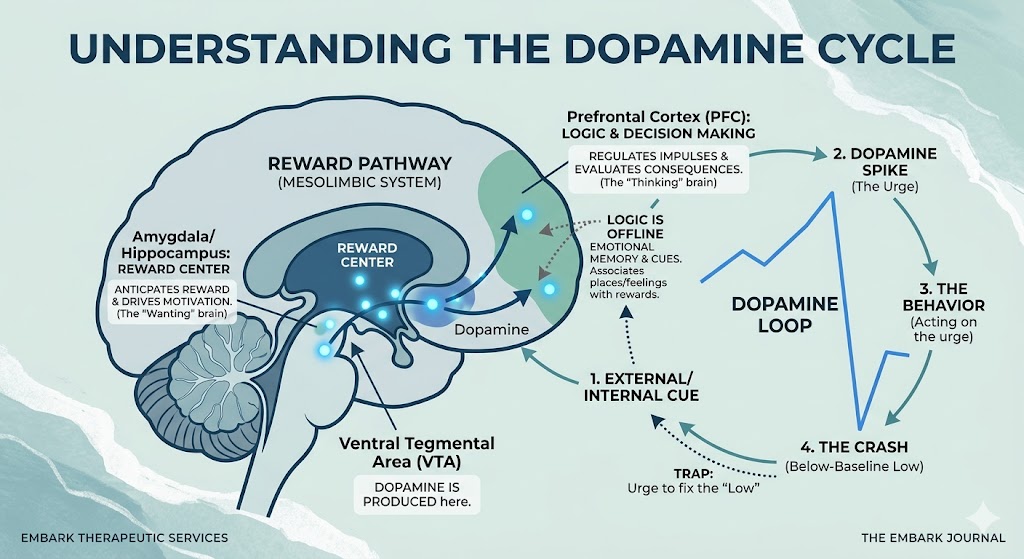
1. The Trigger (The Cue)
You see a notification, walk past a familiar shop, or feel a specific stressor. Your brain recognizes a signal.
2. The Spike (The Wanting)
Dopamine surges. You feel a physical tension or “itch.” Your attention narrows. The behavior becomes the target.
3. The Action (The Behavior)
You engage in the habit. For a moment, the tension breaks.
4. The Crash (The Deficit)
To balance the spike, your brain drops dopamine below baseline. You feel restless, irritable, or low.
5. The Loop Repeats
Your brain learns that the fastest way out of the “low” is another spike. And the cycle continues.
How the Cycle Works: From the initial cue to the dopamine spike, the behavior, the crash, and the urge to repeat — this diagram shows the loop that keeps habits in motion.
Why You Feel "Hijacked"
If you’ve ever felt like you’re watching yourself make a choice you don’t even want to make, you’re not alone—and you’re not “broken.”
When your brain detects a cue, it releases a dopamine spike that creates urgency. In that moment, the part of your brain responsible for long‑term thinking (the prefrontal cortex) becomes quieter. The survival circuits take over.
This isn’t a lack of willpower.
It’s a temporary biological override.
The Dopamine Crash: Why the "Low" Keeps Us Stuck
This is the part of the cycle that keeps us trapped. To balance a dopamine spike, your brain eventually plunges your levels below baseline. This is the "hangover" or the "crash."
The Digital Crash: After an hour of scrolling, you don't feel refreshed; you feel depleted and restless.
The Substance Crash: As the effects wear off, the anxiety or "low" feels worse than the stress you were trying to escape.
The Food Crash: After the binge is done, you feel physically uncomfortable instead of satiated.
Your brain realizes the quickest way to get out of that "low" is to find another "spike," and the cycle begins again. This is why habits feel so heavy—you aren't just chasing a high; you are desperately trying to escape a biological low.
Navigating the Way Forward
Understanding this biology gives us permission to stop shaming ourselves. Instead of fighting our nature, we can work with it and retrain the system.
Normalize the Urge
When the craving hits, try:
“This is my dopamine spiking. My brain thinks this is urgent. I’m safe, and this feeling will pass.”
Lengthen the Gap
Even a 10‑minute pause between the spike and the action can give your thinking brain time to come back online.
Support the Baseline
Sleep, movement, and balanced nutrition help stabilize natural dopamine levels, making the crashes less intense.
Practice Compassionate Curiosity
Shift from “What’s wrong with me?” to “What is my brain trying to soothe right now?”
These small shifts create space for change.
Get Support for Breaking the Cycle
If this cycle feels familiar and you’re looking for support in breaking it, our therapists can help you build new tools and regain a sense of control. Connect with us to get started.
Connect
© 2026 Embark Therapeutic Services, LLC. All rights reserved.
If you're in crisis or feeling unsafe, you don't have to handle it alone. Immediate support is available.
Embark Therapeutic Services, LLC
Navigate
Care Locations
Trauma-informed mental health care grounded in compassion, collaboration, and evidence-based practices.
The information on this website is for educational purposes only and is not a substitute for professional mental health care.
Practice Information
Telehealth services available for Oregon residents